
Written By: Kuldeep Thusu ‘Pumposh’
Melting Roads. Scorching Cities. Drying Rivers —
Understanding the Science Behind Europe’s Extraordinary Heatwave.
“Summer temperatures of 45°C to 48°C are a familiar reality across many parts of India. Yet when much of Europe approached 40°C this year, the consequences were dramatically different. Roads softened, rail services slowed, airports struggled, rivers shrank, power systems came under pressure, and everyday life was disrupted across the continent. This wasn’t just another heatwave. It was the result of an extraordinary combination of weather patterns, geography, engineering and a changing climate—one that captured the world’s attention.”
Is 40°C Really That Unusual?
For most Indians, probably not.
In cities like Delhi, across Rajasthan, Vidarbha, Bundelkhand and several other parts of northern India, temperatures between 45°C and 48°C are a regular part of summer. The heat is exhausting, but life goes on. Markets stay open, traffic keeps moving, and people continue with their daily routines despite the harsh conditions.
Europe, however, experienced something very different.
Known for its relatively mild climate, much of Europe records an average annual temperature of around 9°C to 12°C. Extreme heat has never been a defining feature of life there.
But during May and June 2026, the continent found itself facing an unusually intense heatwave.
Temperatures climbed to nearly 44°C across parts of Spain, France, Italy, Portugal and the Balkans—levels rarely experienced in these regions.
Governments issued Red Heat Alerts.
School schedules were revised.
Rail services were disrupted.
Wildfires spread rapidly.
Hospitals reported a sharp rise in heat-related illnesses.
Authorities urged people to remain indoors during the hottest hours of the day.
Meanwhile, social media filled with images of softened roads and claims of melting car tyres. Videos showing people frying food under direct sunlight quickly went viral. Some accurately reflected the severity of the heat. Others were exaggerated for dramatic effect.
But behind the viral content lay a far more serious reality.
By the end of June, the heatwave had claimed around 1,300 lives, according to official estimates.
One thing had become painfully clear.
Europe simply wasn’t prepared for heat on this scale.
Why Did Europe Struggle So Much?
Before answering that question, we first need to understand something much more basic.
What exactly does temperature tell us?
And perhaps more importantly…
What doesn’t it tell us?
Only then can we understand why the same temperature can produce completely different outcomes in different parts of the world.
Temperature Is More Than Just a Number
Most of us open a weather app, glance at the temperature—40°C… 42°C… 45°C—and assume that’s the whole story.
It isn’t.
Meteorologists look far beyond the number displayed on the screen.
They also consider:
- How humid is the air?
- How intense is the sunlight?
- Is there enough wind to provide cooling?
- How much does the temperature fall after sunset?
- How much heat do buildings and roads retain after dark?
In other words…
Two places can record exactly the same air temperature, yet experience completely different levels of heat stress.
Take the human body as an example.
A temperature of 43°C is physiologically stressful no matter where you are.
But how dangerous it becomes depends largely on the surrounding environment.
Our bodies cool themselves by sweating.
As sweat evaporates, it removes heat from the skin, helping regulate body temperature.
But when humidity is high, sweat evaporates much more slowly.
The body loses its ability to cool itself efficiently.
That’s why 35°C with high humidity can sometimes feel far more uncomfortable—and even more dangerous—than 43°C in a dry climate.
The thermometer tells only part of the story.
The environment determines the rest.
Were Europe’s Roads Really Melting?
Perhaps the most widely discussed images from this heatwave were those showing roads appearing to melt under the blazing sun.
But were they actually melting?
The short answer is yes—but not in the way many people imagine.
Roads don’t suddenly turn into flowing liquid like wax.
What actually happens is that prolonged exposure to intense heat softens the upper layer of the road surface. Under the weight of heavy vehicles, tyre marks begin to appear, the surface can become sticky, and in some cases it starts to deform.
That naturally raises another question.
Does this mean European roads are inferior to those in India?
Not at all.
The truth is much more interesting.
Roads are engineered according to the climate they are expected to face.
In India, engineers know that temperatures above 45°C are a normal part of summer in many regions. Road materials are therefore selected to withstand prolonged exposure to extreme heat.
Europe faces a very different challenge.
For decades, the continent’s biggest concern has not been scorching summers but freezing winters. Roads there must survive snow, ice, repeated freeze-thaw cycles and temperatures that often fall below zero.
That is why the materials used in European roads are designed with different priorities in mind.
In simple terms…
A road that performs exceptionally well during a Scandinavian winter may not perform equally well during a prolonged heatwave in southern Europe.
Likewise, a road designed for the deserts of Rajasthan might not be the ideal choice for regions that spend months under snow and ice.
This isn’t a question of better engineering.
It’s a question of engineering for different climates.
Bitumen and Asphalt: They’re Not the Same Thing
News reports often claimed that “the asphalt melted.”
Strictly speaking, that’s only partly correct.
To understand what really happened, we first need to distinguish between bitumen and asphalt.
Bitumen is a black, sticky, petroleum-based binder.
Its job is to hold together the stone aggregates and sand that make up the road.
Think of it as the glue that keeps everything firmly bonded.
Asphalt, on the other hand, is the finished road-building material.
It is a carefully engineered mixture of bitumen, crushed stone, sand and mineral fillers.
A simple analogy makes the difference easy to understand.
Cement alone doesn’t build a house.
Mix cement with sand and gravel, and you get concrete.
Road construction works in much the same way.
Bitumen is the cement.
Asphalt is the concrete.
So when roads appear to “melt” during a heatwave, it is not the entire road turning into liquid.
Instead, the bitumen within the asphalt begins to soften, reducing the surface’s ability to withstand heavy loads.

________________________________
Why Indian and European Roads Behave Differently
This is where climate becomes the deciding factor.
Roads in India generally contain bitumen grades formulated to tolerate much higher summer temperatures.
European roads, however, are often designed to remain flexible during freezing winters.
That flexibility is essential because repeated freezing and thawing can crack a rigid road surface.
But every engineering solution involves trade-offs.
Materials that perform brilliantly in sub-zero winters may become more vulnerable during prolonged periods of unusually high temperatures.
That doesn’t make European roads poorly built.
It simply means they were designed for a climate that is now beginning to change.
What About the Viral Claims of Melting Tyres?
Social media was flooded with dramatic images claiming that car tyres had melted in the heat.
The available evidence tells a different story.
Rubber tyres do not normally melt simply because the air temperature reaches 40–45°C.
What actually happened in many places was that the softened asphalt began sticking to tyres.
Extremely hot road surfaces also increased tyre wear.
But that is very different from tyres melting.
In other words…
A softening road and a melting tyre are two completely different phenomena.
With the roads explained, another question naturally follows.
If Europe wasn’t built for this kind of heat… why did the continent become so hot in the first place?
To answer that, we have to look far above the roads—into the atmosphere itself. There, an invisible weather pattern known as the Jet Stream quietly set the stage for one of Europe’s most intense heatwaves in recent history.
__________________________________
Why Did Europe Suddenly Become So Hot?
If melting roads were only the visible consequence, what actually triggered the heatwave?
The answer lies high above the Earth’s surface.
And it begins with an invisible river of air.
Europe’s Geography Has Always Protected It from Extreme Heat
India and Europe may occasionally record similar temperatures, but they do not share the same climate.
Most of India lies within the tropical and subtropical belt, where long, hot summers have always been part of life. Our cities, homes, roads and even daily routines have gradually adapted to that reality.
Europe is different.
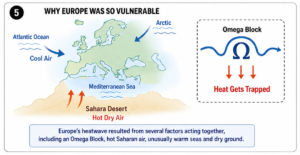
The continent is surrounded by water on three sides—the Atlantic Ocean to the west, the Mediterranean Sea to the south and the Arctic to the north.
These vast water bodies normally act as natural temperature regulators, preventing prolonged spells of extreme heat.
That’s why much of Europe has historically enjoyed relatively mild summers.
But this time, nature followed a different script.
The Jet Stream: An Invisible Highway in the Sky
Around 8 to 12 kilometres above the Earth’s surface, powerful winds race around the planet at remarkable speeds.
These fast-moving air currents are known as the Jet Stream.
Think of them as invisible highways in the atmosphere.
They constantly move weather systems from one region to another.
Warm air is pushed away.
Cooler air moves in.
Clouds form.
Rain falls.
The weather changes.
This continuous movement prevents any single weather pattern from lingering over one place for too long.
But during this heatwave…
That movement slowed dramatically.
And everything changed.
What Is an Omega Block?
The name may sound technical, but the idea is surprisingly simple.
The Jet Stream doesn’t travel in a perfectly straight line.
It meanders across the atmosphere, much like a winding river.
Sometimes those waves become unusually large.
When viewed on weather maps, the pattern resembles the Greek letter Ω (Omega).
Hence the name—
Omega Block.
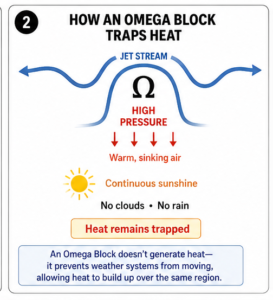
As this pattern forms, a powerful high-pressure system becomes trapped beneath the centre of the atmospheric wave.
At the same time, the usual west-to-east movement of weather systems almost comes to a halt.
The atmosphere, quite literally, gets stuck.
How Does an Omega Block Create a Heatwave?
Under normal conditions, warm air rises.
As it rises, clouds develop, rain becomes possible, and heat gradually escapes into the upper atmosphere.
A high-pressure system disrupts that entire process.
Instead of allowing air to rise, it pushes air downward.
As the air descends, it becomes warmer and drier.
The consequences quickly become visible.
Clouds struggle to form.
Rainfall almost disappears.
Fresh, cooler air cannot move into the region.
Meanwhile, uninterrupted sunshine continues heating the ground day after day.
The result is simple.
The heat doesn’t increase because the Sun suddenly becomes stronger.
It increases because the atmosphere stops allowing that heat to escape.
That’s why an Omega Block is often compared to placing a lid over a pot that’s already heating.
The flame remains the same.
But the trapped heat keeps building.
The Omega Block Was Only Part of the Story
Had the Omega Block been acting alone, the heatwave might not have become so severe.
Several other factors intensified the situation at exactly the same time.
Hot Air Arrived from the Sahara
To the south of Europe lies the Sahara Desert, one of the hottest places on Earth.
During this period, powerful winds transported extremely hot, dry air northwards into southern Europe.
Normally, these hot air masses move on after a short time.
This time, however, the Omega Block prevented them from moving away.
The heat simply remained trapped over the continent.
Even the Mediterranean Couldn’t Provide Relief
The sea usually acts as a natural cooling system.
But during this event, the Mediterranean Sea itself was warmer than average.
Instead of cooling the surrounding regions, it offered much less relief than it normally would.
Europe’s natural air conditioner wasn’t working at full capacity.
Dry Soil Added Even More Heat
This is one of the least understood parts of a heatwave.
When soil contains moisture, a significant portion of the Sun’s energy is used to evaporate water.
That naturally limits how much the land heats up.
But once the soil becomes dry…
Almost all of that energy goes directly into heating the ground and the air above it.
The result is a vicious cycle.
Dry soil produces hotter air.
Hotter air dries the soil even further.
Scientists call this Soil Moisture Feedback.
Did You Know?
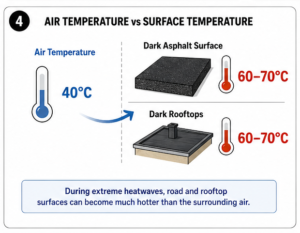
Although air temperatures were around 40°C, the surface of dark roads and rooftops in some locations reached 60–70°C under direct sunlight.
People weren’t just exposed to hot air.
They were surrounded by surfaces radiating enormous amounts of stored heat.
So if the weather was responsible…
Why did cities suffer even more than the countryside?
The answer lies in another phenomenon that is becoming increasingly important in a warming world—
The Urban Heat Island Effect.
______________________________________
Why Did Cities Suffer the Most?
If the weather was responsible for the heatwave, why did cities become far hotter than the surrounding countryside?
The answer lies in a phenomenon known as the Urban Heat Island Effect.
Despite its technical name, the concept is remarkably simple.
Imagine two places.
One is a village surrounded by trees, fields and open land.
The other is a modern city dominated by concrete buildings, asphalt roads and glass towers.
Both receive exactly the same sunlight.
Yet by evening, the city is often several degrees hotter.
Why?
Because cities absorb heat differently.
Roads, buildings and pavements soak up solar energy throughout the day. After sunset, instead of cooling quickly, they slowly release that stored heat back into the surrounding air.
As a result, cities remain warmer long after the sun has gone down.
The problem is made even worse by the shortage of green spaces, the heat generated by vehicles and the warm air expelled by millions of air-conditioning units.
This is what scientists call the Urban Heat Island Effect.
Why European Homes Turned into Heat Traps
The buildings themselves also played an important role.
Homes are designed according to the climate people expect to live in.
In India, houses are traditionally built with heat in mind.
Open windows, shaded balconies, cross-ventilation and ceiling fans help keep indoor temperatures manageable, while air conditioning has become increasingly common in many cities.
Europe followed a very different path.
For generations, the greatest challenge wasn’t keeping homes cool.
It was keeping them warm.
That’s why many European houses are built with thick insulation, double-glazed windows and tightly sealed walls that prevent heat from escaping during winter.
The design works brilliantly in cold weather.
But during an extended heatwave, the same features begin to trap heat indoors.
In effect, many homes behave like insulated containers.
Once they become hot, they cool down only very slowly.
A design once considered an advantage suddenly becomes a disadvantage.
Why Was Air Conditioning So Rare?
For many people outside Europe, one question kept coming up.
Why didn’t people simply switch on their air conditioners?
The answer is straightforward.
In much of Europe, air conditioning was never considered a necessity.
Historically, summers were mild enough that most homes could remain comfortable without it.
As a result, millions of houses, apartments and even older public buildings were built without air-conditioning systems.
When temperatures remained unusually high for several consecutive days—and nights offered almost no relief—indoor temperatures climbed to dangerous levels.
Many people, particularly the elderly, found themselves trapped inside homes that had effectively become ovens.
Several governments responded by opening temporary Cooling Centers, where residents could spend a few hours in air-conditioned environments until conditions improved.
The Crisis Extended Far Beyond Public Health
The consequences of the heatwave weren’t limited to human suffering.
Critical infrastructure also came under enormous pressure.
In parts of Britain, railway operators-imposed speed restrictions because steel tracks can expand and deform under extreme heat.
Across France and Spain, wildfires destroyed thousands of hectares of forest.
One of Europe’s busiest waterways—the Rhine River—experienced unusually low water levels in several sections, disrupting commercial shipping and affecting supply chains across central Europe.
Electricity demand surged as people searched for ways to stay cool.
At the same time, warmer rivers reduced the efficiency of some power stations that rely on river water for cooling.
The heatwave was no longer just a weather event.
It had become an economic, environmental and infrastructural challenge.
Why Heatwaves Can Be Deadly
Heat is often dismissed as little more than discomfort.
In reality, prolonged exposure to extreme temperatures places enormous stress on the human body.
As body temperature rises, the natural cooling system begins to struggle.
This increases the risk of:
- Heat Stroke
- Dehydration
- Cardiovascular stress
- Kidney damage
- Worsening of existing medical conditions
Older adults, young children, pregnant women and people with chronic illnesses are particularly vulnerable.
By the end of June, official figures linked the heatwave to around 1,300 deaths across Europe.
That is why many countries now classify severe heatwaves not merely as weather events, but as public health emergencies.
Is India Really Safe?
Not necessarily.
India is undoubtedly more accustomed to extreme heat than Europe.
But familiarity should never be mistaken for immunity.
Indian cities are expanding rapidly.
Trees are disappearing.
Concrete continues to replace open land.
Urban Heat Island effects are becoming increasingly visible in cities such as Delhi, Mumbai, Pune and Ahmedabad.
Without better urban planning, more green spaces and smarter heat-management strategies, future heatwaves could become even more dangerous.
Europe’s experience serves as a warning—not because India shares the same climate, but because climate risks are evolving everywhere.
The Deep Dive:
Europe’s recent heatwave reminds us of an important truth.
Nature does not adjust its rules to accommodate wealth, technology or modern infrastructure.
A continent that spent centuries designing its cities, homes and roads to survive freezing winters is now being forced to rethink them for a warming future.
The severity of any natural disaster is rarely determined by nature alone.
It is shaped by the interaction between natural events and human choices.
Today, Europe is confronting that reality.
Tomorrow, it could be somewhere else.
Perhaps the most important question is no longer how high the temperature will rise.
The real question is:
Are our cities, our homes and our way of thinking prepared for a changing climate?
Will we wait for the next heatwave… or begin preparing before it arrives?
And perhaps that is the most enduring message of this extraordinary event.
This was not merely Europe’s trial by heat—it was nature’s unmistakable warning about the cost of human complacency.
~~~~~~~ Think About It~~~~~~~
Climate change is real. Heat wave, unseasonal rainfall, lack of seasonal rains, wildfires, floods, droughts, shorter winters ( in India), unpredictable weather conditions…are here to stay. We can’t be blind to climate’s mood-swings which are in fact the result of various destructive human activities….
As we sow, so shall we reap!!!
Thank you so much for your thoughtful comment and for sharing your perspective.
I completely agree that climate change is one of the defining challenges of our time, and many of the extreme weather events we witness today are closely linked to human activities.
The purpose of this article was to understand one such event in its broader scientific and environmental context. I’m glad you found it informative. Thank you once again for reading and contributing to the discussion.