
How Nature and Nurture Shape Who We Become
By: Sheela Kaul
The human mind is a complex landscape where the smallest spark can shape a lifetime.
Every action we take, every habit we form and finally the character we present to the world begins in the quietest corners of our consciousness.
This profound ripple effect is captured perfectly in the timeless wisdom:
“Watch your thoughts, they become words;
watch your words, they become actions;
watch your actions, they become habits;
watch your habits, they become character;
watch your character, for it becomes your destiny.”
{FRANK OUTLAW}
This progression suggests that we are the ultimate architects of our own identity.
However, this blueprint of self- determination raises a fundamental question:
Where do initial thoughts originate ?
While the quote implies total personal control over our destiny, psychology suggests our minds are never a completely blank slate.
Instead, the way we think, speak and act are constantly shaped by interactions and conflicts between our genetic inheritance and our life experiences.
To understand the true mechanics of identity, let’s explore the timeless conflict of Nature vs. NURTURE.
- Are we predestined?
- Are we the product of nature or nurture?
- Are we born with our personalities, or are we shaped by the world around us?
- How we become what we are ?
- What is the role of our genetics in shaping our personalities?
- How does nurture influence in molding our personalities?
- Are we born with a biological template that pre-determines how we perceive the world?
- Are our thoughts gently and / or forcefully molded by our families and our cultures?
The evolution from a helpless infant to a unique individual is a step-by- step process of the brain growing and learning to separate itself from others.
We begin our life with zero control, shaped entirely by our genes and the environment we are born into.
At first, a baby doesn’t even realize it is a separate person from its mother.
However, this total helplessness sets off a predictable chain reaction that forces the child to build its own destiny.
Earliest forms of personality are observed in newborns.
Each infant exhibits observable differences since birth.
An infant evolves into a distinct personality through a continuous interaction between genetics (nature) and environment (nurture).
A child is not born as a blank slate.
He is born with many primitive reflexes for survival, feeding, protection and defense.
As primitive reflexes fade, they are replaced by voluntary learned behavior.
Because all infants start with unique biological bases, their individual differences are often termed as ‘temperament’ .
Over time, this journey gradually layers into a complex character as he interacts with the world.
From the moment an infant is born, he starts to connect with the environment around him.
Here, the baby impacts his environment , and is in turn impacted by his environment.
For ex. if a baby smiles more, is calm and easy to comfort, he elicits relaxed caregiving; whereas a highly reactive baby might test his parents’ patience.
These continuous action-reaction cycles shape how the child learns to regulate emotions and behavior.
As the child grows, his experiences begin to shape, reinforce or modify his traits that gradually develop into a complex character as he interacts with the world.
The journey of personality development begins at conception and continues through life.
All along this journey, an individual keeps on learning and unlearning, getting influenced and also influencing others; keeps on modifying and adapting… over the life course.
How do all these developments and changes happen?
Let’s explore!
What Is Personality?
We all think of personality as a product shaped by upbringing, culture or life experiences.
But long before a child is born, his genetics has already started its foundational brick work.
In fact, his biological groundwork begins at the stage of conception.
Personality is not only how a person looks- how tall or how fair he is, how he walks or how he talks.
It is not only how intelligent or social he is; what he eats or what he wears; how he acts or what he thinks.
He is not only the flesh and blood…. He is a complex product of body, mind and soul.
Personality can be described as a complex expression that connects the physical body, the active mind and the deeper inner self ….
The physical body interacts with the material world through five senses.
The mind is the center of thoughts, memories and reasoning.
It is the main builder of personality traits.
The soul is the inner, unseen essence that helps deal with emotions, maintain clarity of thoughts and values.
It helps in remaining calm and resilient in adversity.
To sum up, personality can be explained as:
- Personality is the unique and relatively stable pattern of thoughts, feelings and behaviors that makes one person different from others.
- It is a characteristic way of thinking, feeling and behaving.
- It embraces moods, attitudes and opinions and is expressed in interactions with other people.
- personality traits are relatively stable in adulthood and account for how people behave.
Key Parts Of Personality
- THOUGHTS – How a person views life, solves problems and makes choices.
- FEELINGS – How a person shows and handles emotions.
- BEHAVIOR – How a person acts with others and everyday habits shown in social groups.
Personality matters the most as it stays mostly the same as we grow.
It is formed by genes and life events.
Nature i.e. genes and Nurture i.e. environment, both influence personality.
WHAT MAKES PERSONALITY – NATURE OR NURTURE
The NATURE vs. NURTURE debate explores how human behavior, intelligence and personality are shaped by biology ( nature) versus environment and upbringing (nurture).
Locke (17th century) saw learners as blank slates, shaped by what happens to them.
Plato and Descartes believed we are born already knowing somethings.
Modern science now believes that development comes from genes and the environment working together.
In such interaction, genes provide biological blueprints and life experiences shape the way those traits are expressed. It is called interactionism.
Development of personality is the result of a dynamic interplay where genes and environment continuously influence each other.
NATURE and NURTURE TRAITS
Pure Nature Examples:
- Nature i.e. genes transmit biological information.
- Nature traits are coded in DNA, biologically inherited and largely immune to environmental changes.
- These genetic traits are passed down from parents to offsprings through generations.
- These include physical features like color of skin, eyes, hair ; height potential etc…
- Genetically determined blood types like – A, B, O, and AB are inherited traits based on the absence or presence of specific carbohydrate tags called antigens. Combining the blood groups ABO with Rh factor creates eight blood groups as A+, A-, B+, B-, AB +, AB-, O+ and O- .
- Sex chromosomes and internal and external anatomical features are determined by genetics.
- Both parents randomly pass on a unique combination of their genes to their children through genetic recombination and independent assortment, creating vast biological variations that provide the foundation for an individual’s unique personality.
- Inborn temperament refers to the natural, biologically rooted behavior and emotional style that dictates how a person reacts to the world.
Pure Nurture Examples:
- NURTURE traits are learned or caused by external surroundings, cultural and individual experiences.
- NURTURE refers to all environmental factors that surround us.
Environmental factors like family, society, school, playground, workplace, friends, peer groups, relatives, teachers / mentors, leaders etc. influence to a great extent.
* Environmental factors also include written works, social media and other informational gadgets.
* Culture transmits learned information. The system of shared ideas, values, rules and behaviors that people acquire through social interactions are passed down through generations.
- One’s social, cultural, religious , professional environment also play a great role in shaping personality.
- Geographical factors like place, climate etc are equally important factors .
- Socio Economic Status of a family also plays its role in personality matters.
Role Of Nature And Nurture In Personality Development
QUERIES:
- An individual who is academically very successful – is it because he is genetically predisposed to high level of intelligence OR it is a result of an enriched environment and high quality education ?
- An individual who is struggling with anger issues – is it because he has inherited violent tendencies OR he has experienced / observed violence in his environment ?
- A person may inherit intelligent genes, but what if the environment he acquires is adverse, unresponsive or dismissive?
NATURE and NURTURE work Together
Many studies show that both nature and nurture hold equal sway over our personalities.
Traits rarely operate in vacuum ; genes set a baseline while environmental factors influence how those traits are expressed.
It is equally significant to note that genetically driven behaviors shape our environment in the same way our environment shapes us.
Examples :
Intelligence and Personality
Intelligence is a major cognitive asset for learning and solving problems.
It is the ability to think, reason, understand, learn from experiences and act logically.
It is the result of both inherited genetic factors and acquired environmental influences.
- Generally, offsprings inherit roughly 40% – 60% of their intelligence directly from their parents through DNA. The remaining portion is shaped by environmental factors like nutrition, upbringing and education.
- The influence of genetics on intelligence increases with age. In toddlers, genetics account for roughly 20% of intelligence, because of the immediate environment – dominance of parents, family, nutrition etc.
- By adulthood, the genetic heritability of intelligence rises to 60% – 80%. As individuals become independent, they use their genetically driven preferences to choose their environmental factors (career paths, hobbies etc.), which help them in expressing their inherited cognitive potentials.
- As a child receives a random 50-50 mix of DNA from each parent, the exact combination of ‘ intelligence-boosting ‘ genetic variations change with every generation. Though highly intelligent parents are statistically much more likely to have intelligent children, it is not a perfect 1:1 transfer.
Proper educational environment , nutrition, upbringing, guidance and practice help in potential development of cognitive abilities.
Genetics and Twin Study
- Twin and Adoption studies show that genetics account for roughly 50% of the differences in intelligence. Genes provide the baseline capacity for cognitive functions like – memory, processing speed and verbal ability. Another 50% (roughly) difference accounts for environmental factors like – parenting, schooling, nutrition and life experiences.
- Identical Twin Study: Identical twins share all their genes; they are more alike.
To determine the impact of genetics on the development, researchers separated identical twins shortly after birth.
They were raised in different families. By raising them apart, researchers could influence their development.
The findings showed significant similarities in their IQ scores, personality traits and cognitive development.
While most of the results were attributed to genetics, the environment still played an important role.
3. Adoptions: Regarding adoptions, there is a genetic link when children turn out like their birth parents (biological parents).
In these cases, a child’s IQ and core temperament often align with his biological parents, even if the two (parents and children) were separated early.
Adoptive children share genes with their biological parents but share a home environment with their adoptive parents.
Their values, manners and beliefs are shaped by the environment and active parenting.
In some cases, adoptive children score higher than their biological parents do. So, the environment a child grows up in matters too.
Impact of Environmental Support
- An individual may inherit a naturally cautious temperament, but the environment can influence whether that caution develops into confidence, anxiety or careful decision making.
Someone may have a biological risk for a mental health condition, but family support, medical treatment and life experiences can help in managing behavioral outcomes.
Similarly, adverse social factors, negligence and untamed stress levels can badly impact the affected person over time.
2. Athletic abilities have strong genetic potentials, but require proper environment, nutrition and practice to develop fully.
A person may be born with some athletic traits, but coaching, practice, nutrition and access to opportunities can shape how far those abilities go.
Lack of opportunities, consistent neglect or discouragement can suppress that trait.
3. Many children are born with certain physical health conditions which hamper their growth in life.
With the help of their families, specific opportunities and encouragement, they can improve their lives and live with dignity.
For e.g., there are special schools for children with visual, hearing or speech disabilities.
Many disabled individuals, whether the disability is from birth or by accident, are given training in some vocations, athletics or similar other activities so that they can live their lives with dignity.
Family Impact: Parenting and Personality
Parenting styles significantly shape long-term personality traits, emotional regulations and social competence.
Parenting styles are parents’ psychological designs for raising their children.
The important dimensions of parenting are varying degrees of ‘responsiveness ‘ and ‘demandingness’.
‘Responsiveness’ refers to the support, affection, warmth, acceptance and guidance a parent gives to a child to encourage all round development.
‘Demandingness’ refers to the level of setting and enforcing rules and expectations by the parents in controlling a child’s behavior and maturity level.
The balancing of these dimensions decide how the child turns out to be.
These parenting styles are :
(A) Authoritative style – ( High demandingness, High Responsiveness):
Parents set clear rules and expectations with logic and reasoning.
They listen to their children and offer support and guidance.
This style is associated with positive traits like high self-esteem, self-regulation, emotional maturity and independence.
The style very positively helps in the upbringing of all-round successful children.
(B) Authoritarian Style – ( High Demandingness, Low Responsiveness ):
Here, parents enforce strict and rigid rules with a one way communication. Parents use ‘because I said so ‘ attitude.
Mistakes are met with punishments rather than guidance.
So, children tend to be obedient and well-behaved outwardly but often struggle with low self-esteem, shyness and social ineptitude.
Children are more likely to lie to avoid punishment . They likely suppress anger and may turn out rebellious later in life.
(C) Permissive Style – ( Low Demandingness, High Responsiveness) :
Here, parents are warm, loving and very lenient.
They set few boundaries, rules and demands.
The impact of such parenting is that children may grow up warm and expressive and are more open .
But they often struggle with self-regulation, impulsivity and entitlement.
They may experience difficulty with authority figures and face higher risk of emotional and behavioral dysregulation.
(D) Uninvolved / Neglectful Style – ( Low Demandingness, Low Responsiveness ) :
Some parents become detached from their child’s life.
Though they provide basic physical and minimal needs and fulfil their basic parenting duties, they offer little guidance and support to their children.
These parents may be indifferent, unresponsive and dismissive.
Some parents may become physically and emotionally abusive.
The impact of such parenting style is very adverse.
Such children frequently exhibit low self-esteem, emotional detachment and mistrust.
They tend to struggle in school and society.
They may experience anxiety, depression and emotional outbursts.
Socio -Economic Status
- Socioeconomic status (SES) measured by income, education and occupation – influence personality development and behavioral tendencies throughout life.
Higher SES is linked to better health, better nutrition, proper education, care and longer life.
Individuals with higher SES often live in safer and stable homes.
Children belonging to higher SES families often have access to good educational and health facilities.
They have enriching experiences that promote traits like confidence and resilience.
2. Lower SES families may live in overcrowded and unhygienic places affecting their physical and mental health.
Financial difficulties, limited access to quality education and health, and limited opportunities – hinder their chances for betterment.
Lower SES families struggle to meet their basic needs. Living a life of deprivation may lead to higher anxiety and low self -esteem.
Peer Pressure
- Peer Influence: Adolescence is a transitional period between childhood and adulthood that builds the physical, mental and social foundation for entire adult life. During adolescence, peer pressure plays an important role in personality development.
- Individuals get influenced to change their attitudes, values or behavior to match the peer group. The need for social acceptance and belongingness can drive changes in behavior and attitudes in both good or bad ways.
(A) Negative peer pressure drives individuals towards risky, harmful, unhealthy behaviors or anti-social activities.
(B) Positive peer pressure encourages helpful or healthy habits like studying for school, joining sports teams, doing some social work, exercising, forming music bands etc.
Friendships can encourage specific traits like sociability or conformity and can also act as a buffer against certain negative influences.
Physiology and Personality
Physiology shapes personality development by linking biological systems, brain structure and neurochemistry to consistent patterns of behavior and emotions.
The pituitary gland is the master of the body.
It produces hormones that tell other glands what to do.
Too much or too little hormones trigger certain chemical reactions which impact body functions.
Hormonal imbalance causes changes in brain functions.
Many pituitary disorders have a genetic basis which can cause significant psychological effects like – anxiety, depression, cognitive dysfunctions etc.
Thyroid imbalance impacts a person’s energy levels, appetite, behavior, sociability and mental ability.
Hormones play a great role in regulating stress responses, emotional reasoning, social skills and over all mental ability.
As per behavioral endocrinology study, the relationship between harmones and behavior work bi-directionally.
Hormones influence behavior and in turn, behavior influences hormone levels.
Genetics set the baseline risk, but lifestyle choices like – diet, physical activities and body weight – play a huge role in whether the condition actually develops into disorders.
Some common genetically inherited harmonal disorders like Type -2 Diabetes, Polycystic Ovary Syndrome (PCOS), Autoimmune Thyroid Diseases are driven by a mix of inherited genes and environmental triggers. When combined, they create a cascading impact on metabolism, harmones and long-term health.
People need conscious efforts to come out of the vicious cycle of unhealthy food habits, sedentary lifestyle and mentally toxic environment.
Metabolic hereditary factors have indirect but real consequences for personality expressions.
Impact of Nervous System
- The nervous system is the most fundamental system that contributes to the genetically acquired aspects of personality development.
The brain , the most important part of the nervous system, acts as the body’s command center. Its structure, functions and connectivity are greatly shaped by genetics.
2. About one- third of human genes express themselves in the brain.
Connectivity patterns of the brain are linked to core personality traits including – tendency of negative emotions; tendency of being social, energetic; and tendency of being more organized, hardworking and responsible.
Cognitive and intellectual capabilities are closely related to the complexity of the nervous system.
3. Genetically inherited neurological disposition determines whether a person adjusts more easily to social environments and develops healthier relationships, or his emotional reactivity makes social adjustments more difficult.
4. Psychologists believe that genetic compositions and social experiences interact to shape neuro-biological and psychological functions. It reinforces the idea that nature and nurture work together.
Cultural Context
- Cultural background also shapes personality by dictating social norms and values. In western culture, societies are self-reliant, individualistic, believe in personal freedom and achievements and self-expression.
- Collectivist culture, prevalent in many Asian and African countries , fosters family harmony, group needs and community belongingness. In these societies, individuals are interconnected to larger groups rather than as independent agents. They believe in cooperation and respect for authority.
Influence of Social Media on Personality
Social media has made the entire world available at our fingertips.
It has been ingrained in people’s lives. Its users have a deep and rich experience in involvement, engagement and cooperation.
The influence of social media on young minds is shaped by many complex factors:
They include – the amount of time spent on social media platforms.
The type of content they consume or are exposed to.
The activities and interactions they are involved with.
And, the degree to which it disrupts their daily essential physical activities.
Different individuals are affected by social media in different ways based on their individual strengths, vulnerabilities, socio- economic- cultural backgrounds, family supervision etc.
It has the potential to both benefit and harm children and adolescents.
Social media shapes personality by intensifying traits like neuroticism and extraversion, fostering selective and idealized self- presentation and driving social comparisons that impact self-esteem.
Positive influence :
Social Media can provide benefits by connecting with the world , sharing ideas, abilities and interests.
It can create a space for self-expression, friendships, and positive interactions with more diverse groups.
It helps to raise awareness on important issues and find peer support.
It provides an outlet for shy or socially anxious individuals for self-expression.
Negative Influence :
The negative impact of social media on impressionable minds is very concerning.
Social media platforms are full of all kinds of information – truths, half-truths , falsehood, make-believe content etc.
Filtered information with hidden designs gets huge traction.
It creates false perception, fuels unhealthy social comparisons and lower self- esteem .
It triggers fear of missing out (FOMO).
There is high risk of poor mental health outcomes including symptoms of depression, anxiety, stress and isolation.
Online platforms can be breeding grounds for cyber- bullying and cyber- frauds, which can have severe psychological consequences for all.
The digital landscape does not just change how we interact; it rewires how we perceive our own worth. It is, thus, crucial that we master the tool rather than let it define our identity.

GEOGRAPHICAL FACTORS
Geographical factors and physical surroundings significantly shape human behavior and personality traits.
Physical surroundings like climate, terrain, urban or rural settings directly affect daily habits and long-term behavior.
- People living in regions with moderate and comfortable temperatures are linked to higher emotional stability, harmony, conscientiousness, reasoning, sociability etc. Whereas extreme heat or harsh weather conditions can alter daily social interactions, emotional expressions and mood regulations.
(A) Water bodies, coastline and dense urban settings are positively linked to openness to exploration, cultural diversity and various activities.
(B) Rural and farming landscapes instill higher levels of conscientiousness shaped by structured, disciplined and hardworking demands of farm life.
(C) Altitude variations and rugged terrain correlate with distinct regional and cultural personality. Direct physical pressures from environment like – climate, resource availability and terrain- constrain or encourage specific daily habits.
(D) Local history and geography give rise to distinct behavioral patterns in mountainous or rural regions, which often emphasize self-reliance.
(E) People actively choose or move to living environments that match their natural inclinations. For example, introverts move to peaceful rural or wooded areas and extroverts move towards bustling areas.
Some people like to live in peaceful areas away from crowds, chaos and noise. Whereas, some other people may like fast-paced flashy city lifestyles.
Many people find the constant motion, noise and collective momentum of a crowd exhilarating.
The places we inhibit do more than just shelter us.
While genetics provide a baseline for who we are, the physical geography around us acts as a quiet, lifelong collaborator in shaping our daily outlook and temperament.
The terrains we navigate demand different versions of us – coastal areas promote openness, while harsh, isolated environments demand fierce self- reliance. In the end, we do not just live in a landscape, the landscape lives in us.
Ultimately, the journey from a helpless infant into an independent personality reveals that we are neither bound by fate nor entirely free.
We began as entirely dependent on others but evolve into independent personalities forged by our choices and habits through social boundaries.
In the end, how we become what we are is not a mystery of the stars, but a triumph of human psychology – proving that our personality is the closest thing to destiny.
The Deep Dive:
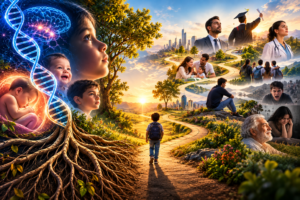
We are born with a genetic inheritance, but not with a fully written destiny.
Our genes may provide the foundation, yet the person we become is shaped by far more than biology alone.
From the warmth of a family to the influence of education, culture, friendships, social circumstances and life experiences, every interaction leaves its imprint.
Even our struggles, opportunities and personal choices contribute to the gradual evolution of our personality.
What makes this relationship particularly fascinating is that nature and nurture do not operate independently.
Our inherited tendencies influence how we respond to the world, while the world around us can strengthen, soften or reshape those tendencies.
This exploration reminds us that human personality is neither entirely inherited nor simply acquired.
It is a lifelong process of learning, adapting and becoming.
Our roots may explain where we begin, but our routes help shape who we become.









Sheela ji, a thoughtful and insightful piece of writing!
What I particularly appreciate from an editorial perspective is how you have brought together genetics, upbringing, culture, social influences and life experiences to explore the making of human personality.
Your article goes beyond the familiar Nature vs. Nurture debate and encourages readers to reflect on what truly shapes who we become.
Thank you for this valuable contribution to *TheWhyLens*. It’s a pleasure to feature your work, and I look forward to more such meaningful contributions.
**— Pumposh**
Editor, TheWhyLens
Mr. editor, thanks for your kind words. I found this platform very inclusive, clutter-free and supportive. This is a platform where informative, relevant work and material from authentic sources find space for expression. It is my small contribution and i thank you for giving me space.